Showing posts with label Libraries. Show all posts

Tuesday, 30 September 2008

An Irish Example


It's great to hear some good news from libraries and the Irish libraries council has just that in the 2007 PLUS report (pdf) let's sing a few praises:
82% rate the book choice as Good or Very Good
81% said they were successful in finding what they wanted
98% found the staff service Good or Very Good
92% rated the staff's knowledge of library equipment Good or Very Good
96% said libraries are a safe place to visit
93%  rated the service overall as Good or Very Good

And visits are up 17% on last year....

Tuesday, 23 September 2008

m.libraries

Today could well be a watershed in mobile technologies. The first phone running Google Android has been announced - T-Mobile's G1. Android is absolutely a new approach - the hardware is just a platform for the software and User Interface. This in itself isn't really that different from Microsoft have traditionally offered - and puts google right opposite Apple (the iPhone is a total hardware/software solution and Apple have taken steps to tightly control that software).

I don't think that google will cause a revolution for mobile use but I do think it adds fuel to the evolution that Nokia, Windows Mobile and the iPhone have been part of, and in this post I'm going to take a deep breath of realism and explore some of the issues that might well affect libraries in a 'mobile age'.

The web is a platform -  the mobile web as a separate approach is coming to an end. We need to move to technologies and systems which work on all kinds of devices- and we need to start now. This has some significant impacts on our catalogue technologies and especially on the navigation structures we have in place for our web content.

Geography is important - we can assume that phones will be location sensitive (GPS most likely) and we need to see if our services can be delivered spatially. People are beginning to expect maps on the web but the need for kml delivered via web and local applications is not far away.

Little Bits for Short Attention Spans - Don't worry, there's no criticism of the web ruining our ability to think long-term from me. My gut feeling is that we just value our attention more - and will no longer spend it on things which we can get in shorter time. We need to think about how we can present our resources in small 'bits' which people can consume on the move or in "attention gaps".

A SIM for Everything - One of the principles behind IPv6 was that more devices would be coming on line over the next 5-10 years and that these would all need IP addresses. The 3G SIM is likely to be the gateway to in-car, mobile and embedded networked connectivity and we need to think ahead to what might have a SIM in it in the future? In some ways it's hard to think of what won't... certainly any environment in which you spend any significant period of time will probably be home to a connected device.

Every part of our industry - from system vendors down to content makers - has to start thinking now about mobile technologies. Text message reminders for loans is all well and good but we have to provide our services in a more agnostic way to allow us promote use on mobile devices into the future - who knows what form they'll take.


Sunday, 21 September 2008

Change or Be Changed?

It's great to see more publicity about 'modern' libraries but what interests me most about this article from The Times is the comments that have been left. It's not uncommon to hear librarians complain that Libraries are something that "people want to have, not to use" - that is to say that a library is a sign of a healthy society, even if it's empty.

Lots of the comments reference Camden's approach as "dumbing down" or attempting to pander to the "lowest common denominator" but the fact of the matter is if people want libraries to stay as quiet places of 'serious study' they need to start using them! You can't blame us for trying to actually get people to use Libraries can you?

Friday, 19 September 2008

Stats from Scotland

An interesting post about how Scottish school students are primarily using their libraries to borrow books. It's great that 67% of young people in Scotland use the borrowing facilities of their libraries but I wonder how this reflects on the emphasis being put on 'value-added' services (DVD rental, Internet Access and latterly video-gaming) - the Library 'brand' still means books for most, for better or for worse.

Monday, 8 September 2008

Pimp My Bookcart


Now this is a great idea - looking at the results from last year it's one to keep your eye on... I don't think much of the prizes though! 

Tuesday, 2 September 2008

SOPAC, NOPAC

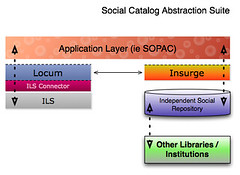
It's not uncommon for users to mix up a library's OPAC and website and why not? Gone are the days when a database of any description was kept distinct from it's host website. In fact, libraries are some of the worst offenders in terms of drawing artificial lines between services.

So it's of real interest to me that Darien Library has just launched it's combined website/OPAC. Essentially they've built a Drupal module that ties, via a connector, to any ILS - more here. It's a really neat move, and one which I'm sure we'll all be watching with interest.

Microsoft Surface


Engadget has reported that Sheraton Hotels have started to install a few Microsoft Surface stations in their hotels. I think these are one of the coolest things ever for libraries. The Object Recognition element should be fantastic for anyone with digital content which can be used to enhance physical material.

Forget the capacity for actually accessing, flipping pages and interacting with digital content for the moment (although this does take the 'Turning the Pages' idea to a whole new level). Instead I can see the system recognising ISBN'd material lain on top of it from the barcode and unique material from the (equally unique) back surfaces.

From there you can see how interpretive data created by libraries and user comments can be lain around the surface, with the physical item linked to all kinds of complementary digital content - whether it be "See also..." type information, biographies or user reviews. In addition, library services can be marketed by laying them out next to relevant material.

There's not much information on how cultural organisations might use this kind of technology - Microsoft seems to be pitching this at Bars and, obviously, Hotels. It's a shame because I can honestly see museums loving this as a concept - and libraries should too.

Monday, 1 September 2008

Online Poster Goodness

A fair few library bloggers have been singing the praises of the ALA Online Poster Maker which allows anyone and everyone to create their own poster to compliment the ALA's own promotional efforts.

What a great idea! Whilst 'outline' posters are available for lots of different library promotional programmes, allowing the public to make use of them is a new thing. The National Year of Reading website (for England only) allows you to play with the logo and 'design your own' - which is a nice touch - but the ALA interface really benefits from its simplicity (although, a few more designs would be nice).

Plus, "READ" is such a great slogan (if such a simple thing counts as a slogan) - it gets round the whole "shouldn't we say that libraries have more than books?" temptation that seems to raise it's head whenever more than three librarians get together. More please!

Sunday, 31 August 2008

Attention Searchers!

Reading about the recently released Pew search engine use report (via LibrarianInBlack) [pdf] only serves to remind us all how searching has become an inherent part of online life.

Search is a really important thing to me. Almost everything that I do is focused around making material accessible to the end user (either now or over time) and search is a huge part of that. Search isn't just something that the public use, it's also of critical importance to staff, but it's the end user who is likely to have the most difficulty with a new search interface.

When I was a researcher, and a user of the resources I now play a part in providing, I sought information in ways which seem somewhat insane to me now. How I ever found anything of use is beyond me. Let me give you a quick précis of my "search strategy":
  1. Fire a keyword into the OPAC (at this point I was only looking at printed material, I had no idea that there was anything else available or how to search it)
  2. Scan down the results and order anything that looked vaguely relevant (it's free right?)1
  3. Look at my stack of material and immediately sort it based on the cover, blurb and index
  4. Read the four remaining books and note down the references that looked useful
  5. Go back to the OPAC and request those items (or at least those that I could easily find). Rinse and repeat.
(For me, journals weren't something you searched; you'd read the last 5 years worth and only go further back if there were specific articles referenced in other papers.)

That little vignette helps to remind me that even though I now know about authorities, subject headings, cross references and formats there's no reason that end users do or even should.

The perennial question with searching surrounds how much effort you expect users to put in to the locating of material. The problem is that every searcher, every potential user, has a different level of attention2 that they're willing to spend on the search process. Here's a few examples:

An undergraduate student might be happy with any resource which gives them some level of information and might spend very little time searching. These are the searchers who might favour instant access (think e-Journals) and small results sets.

A family history researcher might be looking for one specific document (a probate record, a historic map, etc) or for any information related to a particular individual. They might have higher reserves of attention but they are looking for specific items, reference number searches, combinations and authorities are key for these people.

A professional researcher (academic or otherwise) might want to be more comprehensive, they might want access to a wide range of unique material or to take long and complex journeys through policy documents. Their level of attention is high when it comes to exploring the material but lower when it comes to locating that material. Unlike the undergraduate they're not looking for 'a resource' but 'the resource' however in contrast to the family history researcher they might not have a clear idea what that resource is or even what form it might take. For these types of searchers the ability to easily combine complex searches is key.

Members of staff are likely to be looking for specific records rather than items (as cataloguers or desk staff) and have the highest level of attention. They can tap into the resources required to use back-end search tools and to restrict searches by elements which they can be confident are in the data and they have the knowledge of the collections required to limit searches from the outset. Staff will know to use control numbers where possible and to follow the rules of controlled vocabulary.
Of course, in a perfect world we could answer all these needs simply by presenting the user with an empty search box, google-style. However, we have to remember that google and libraries aren't the same thing. Firstly, google's success and revenue comes from accumulating small amounts of attention from a large amount of people - in essence, it's in google's interests to provide the resource that's selected only at the point where the users attention is almost exhausted (of course, you can't bank on any specific level of attention so it's best to try and get the most appropriate result first).

Secondly, google indexes data more than metadata. Despite the trends towards the digital most of our material as cultural organisations is not searchable in any kind of thorough fashion. Instead we're limited to hand made metadata records which are not only subjective but also tread the line between brevity and usefulness. Finally, the creators of web content (and the systems which serve that content) are often concerned with making it easy for google to index their data, if publishers of traditional material had the same incentive perhaps we'd see them providing high quality catalogue records themselves?

How do we give the reader the tools they need to find the resources they want within the attention they're willing to spend? If we think they'll read them and make use of them we can produce guides, give training sessions and create FAQs and this kind of strategy will work for members of staff.

But for users these kind of approaches aren't ever going to be as effective. A struggling searcher might look to help guides and FAQs if they are confident that the item they seek is in the collections, or might make an enquiry about the item at the desk or via email. Or, they might just as easily give up. Realistically it's too much to expect that users will pre-read documentation on searching before just entering a search but we shouldn't under estimate the willingness of users to learn from failed searches and to improve their own strategies (assuming that the data they're searching is consistent enough to support this...).

I can see how facets, FRBR/RDA, WorldCat, exposure to google and other record combining approaches will help to move us beyond the current library OPAC search provision but even then I'm not convinced that they represent a panacea. It's interesting to note that some libraries are now providing a request form for material that cannot be found on the OPAC (note: that's subtly different from material that isn't on the OPAC and accepts that the gap between some users and the OPAC is too large).

We often try and elevate google as a shining example of simple searching for complex data but we have to remember that they're starting from a different position. If google were to swap content with a large library or archive it's probable that they would start their resource discovery work with a programme of mass digitisation which would facilitate the full indexing of the resources. Of course, that's one option for libraries but in lieu of a huge input of funds we can still take steps to improve search-based resource discovery.
  • Improve metadata - by making use of auxiliary resources, upgrading records from other systems and by making sure that our cataloguing is not only consistent but also focuses on the provision of metadata hooks which explicitly facilitate search strategies which we expect users to use.
  • Improve Search Interfaces - if the metadata is the fuel, the search mechanism is the engine. It's not unreasonable to expect that search interfaces will need to be tweaked, upgraded and even replaced on a more regular cycle than library systems have required in the past.
  • Expose Your Metadata - Every hit on your metadata, regardless of where that takes place, is a potential use. Exposing good quality metadata to sector and non-sector resources (including search engines) is key to getting someone into the system. If someone only uses google to find records in your library system this does not constitute a failure - they've found the resource haven't they?
  • Provide Simple Help Focused On Particular Uses - Where there's attention to be spent provide resources which shortcut the learning process (including making good use of the "zero results" page). However, general information is only useful if you're looking to support general searching - if you know your users want to search one particular collection provide a very simple 'how-to' for that collection with some tips.
  • Study Users - Ouch. It had to come didn't it? Usability studies cost money and are often ineffective. A large proportion of studies are conducted with pre-determined groups (often existing users) and flag up detailed problems which experienced find irritating - this can be useful but you need to think about all those people who spent their attention long before becoming an experienced user and as a result feel alienated.


1 This is why I ordered one particular children's book, with an appropriate seeming title, over and over again. Subject headings? What are subject headings?

2 If you haven't read Davenport & Beck's book you need to - seriously.

Saturday, 30 August 2008

Library Lending: A Northern Hemisphere Phenomenon?

Take a close look at this map1 of "books borrowed from public libraries - which lend books to members for free or for a nominal charge." and you can see two things; firstly, most of the lending seems to take place in the nortnern hemisphere (where's Australia?) and secondly the poorest countries seem to come have the least lending of all - in fact the entire continent of Africa is reduced to a thin line.

It's also worth noting the obvious lending culture in Eastern Europe and how Japan still lends large amounts of material even though it is a highly technologised culture. I was also shocked by how low levels for Ireland are (compare to Northern Ireland for example).

Now, these figures are from 1999 and since then Ireland has developed the fantastic BorrowBooks.ie service (which helped inform our own Cat Cymru developments), allowing inter-lending across the country via the web, so I'll be interested to know if the levels have increased since and by how much.

As a final point of note: the UK is huge (it looked at first like Scandinavia to me), which implies that our level of lending is something to be proud of. With all the rhetoric surrounding declining usage I think we should be careful to look at global trends (economic and cultural) along side our own local statistics.


1 It's well worth checking out the pdf for the map, which has more raw data.

Friday, 29 August 2008

Injecting some GLAMour into libraries

I've just come back from the 2008 Society of Archivists' Conference in York1 and it's made me think yet again about how artificial the boundary between cultural institutions has become.

I've spoken at the annual SOA event a few times and each time I've taken pains to say that I work in "a library, an archive, a museum and more..." to reflect the quantity and diversity of our collections.

As someone who came from outside the sector I have sometimes had difficulty differentiating between the archival and library functions (the best description I've heard thus far has been that a big library is "at the same time an artisan chocolatier and a high-volume sausage factory"!). Highly skilled staff can delicately tease the key themes and structures from a seemingly incomprehensible array of personal papers and diaries whilst others can pull in hundreds of catalogue records for legal deposit material through z39.50.

The role of Museums, Libraries and Archives seems to be merging ever closer - we already have some convergence at the policy level (at least in Wales and England) - and it's getting harder to determine collection policies as data stubbornly refuses to fit into our existing boxes.

Lorcan Dempsey adds Galleries to the list and calls them 'GLAM', which I have to say has a nice ring to it. In many ways we're all trying to be a bit more GLAMorous; improving access to our material and attracting the public to our resources, whether online or in person.

Convergence is, however, not the same as unity. We can learn from each other as organisations - that much is clear - but there are still some fundamental differences in terms of training, perspective and operation. True, archives are showing off their unique collections, libraries are leaning more towards interpretation and everyone is engaging with the visual medium of the web but there's still life in the old constructs yet.

As an example, Librarians view everything on the web as published, but a large proportion of this is unique material which fits into our traditional view of archival material - either way a lot of it is ephemeral. In the digital age we can all have a copy, so this shouldn't be a problem (remember, LOCKSS is a philosophy, not just software!) but we can't really afford to duplicate effort so the problem remains.

The challenge for those of us working in GLAMorous organisations is to find out what terms and activities best link in to the public psyche in an age of Google Books, self-archiving, free museums and Who Do You Think You Are? without compromising our core values as cultural organisations.


1 By the way, the irony of the all the SOA conference information disappearing from the website on the last day of the event isn't lost on me. This is a prime example of how a CMS can be anti-informational.